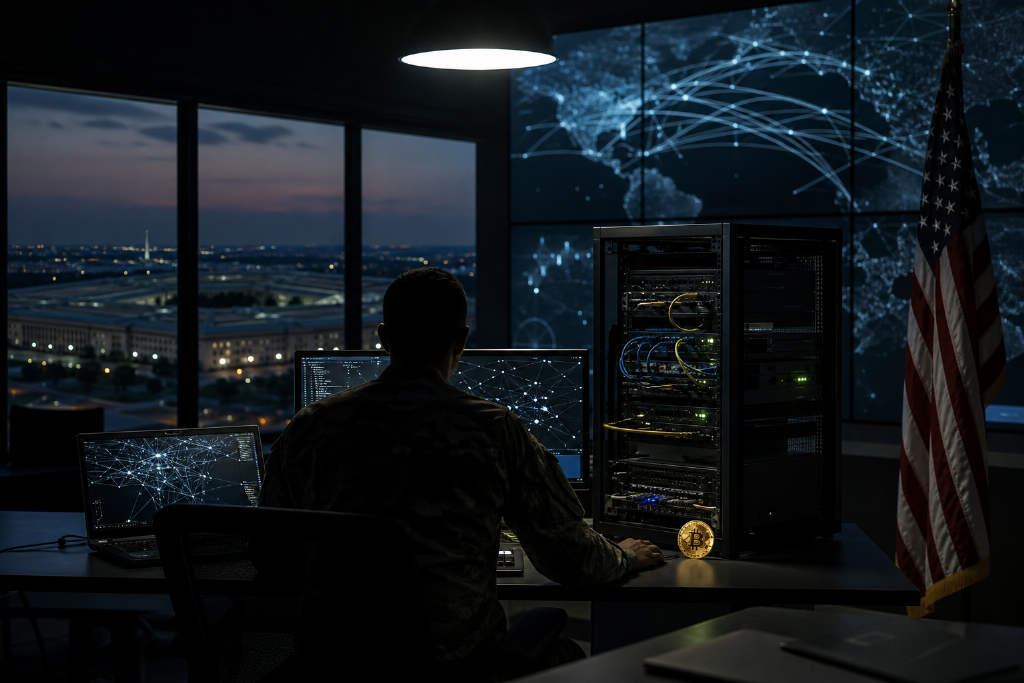
U.S. military2026-08-19 16:19:26U.S. military confirms it is running a Bitcoin node to strengthen cybersecurityThe U.S. military has confirmed that it is running a Bitcoin node, according to a Techub News brief citing Crypto Briefing. The stated purpose is to strengthen cybersecurity. The report adds that the move highlights the strategic importance of blockchain technology in the defense sector. No further operational details were provided in the source brief, including which branch of the military is involved, where the node is being operated, or when the deployment began. Based on the information available, the confirmation centers on the military’s use of Bitcoin network infrastructure as part of a cybersecurity-related effort. The brief frames the development as a sign that blockchain technology is being recognized for its strategic value in national defense settings.990
Moltbook2026-07-23 23:20:16Moltbook AI Agents Network Goes Viral: 150K Bots, Bitcoin Wallet, and MOLT Token Surges 22%Moltbook, a Reddit-like social network for AI agents only, has attracted 150K agents across 12K self-run communities. One agent set up a Bitcoin node and wallet, sparking debates on machine autonomy. MOLT token jumped 22% in 24 hours to $0.00090 with $124M volume.1790
Bitcoin node2026-07-22 20:25:14US Indo-Pacific Command Runs Bitcoin Node, Cites Potential in Power Projection Against ChinaFour-star Navy Admiral Samuel Paparo told Congress that INDOPACOM is operating a live Bitcoin full node for monitoring and network security tests. He called Bitcoin a tool for American "power projection" and national security, marking the first public confirmation of direct U.S. military participation in the Bitcoin network.1900
FutureBit2026-07-02 18:45:14FutureBit Launches Apollo III: A U.S.-Engineered Home Bitcoin Miner with Full NodeFutureBit has unveiled the Apollo III, a home Bitcoin mining system that combines a high-performance miner with a full Bitcoin node in a desktop form factor. Built around next-generation 3nm American-designed ASICs and a custom controller, it delivers up to 18 TH/s in Turbo mode and 15 J/TH efficiency in Eco mode. The device supports solo mining and is designed for continuous home or office use. Founder John Stefanopoulos highlights its role in democratizing hash power and strengthening Bitcoin decentralization, building on the company's 2024 milestone of mining a modern-era sovereign solo block. The article covers specifications, design philosophy, and the broader significance of home mining for network resilience.700
Satoshi Schol2026-07-02 08:00:14Scotland's Lomond School Launches Fully Funded Bitcoin Scholarship for Global StudentsLomond School in Helensburgh, Scotland, has announced a fully funded 'Satoshi Scholarship' covering two years of tuition and boarding, open to worldwide applicants with a deadline of May 24. The school, which became the first globally to accept Bitcoin for tuition in autumn 2025, also runs its own Bitcoin node and mining rigs, using waste heat for classrooms and displaying a live mempool in the library. In partnership with economist Saifedean Ammous, author of 'The Bitcoin Standard,' the school is developing a curriculum blending Bitcoin with Austrian economics, integrating crypto education into daily school life.1850
Bitcoin node2026-07-02 04:20:14U.S. Indo-Pacific Command Reveals Running a Bitcoin Node: Using Proof-of-Work to Strengthen CybersecurityAdmiral Samuel Paparo, commander of U.S. Indo-Pacific Command (INDOPACOM), confirmed to the House Armed Services Committee that the U.S. military is operating a Bitcoin node and conducting operational tests to secure networks using the Bitcoin protocol. In Senate testimony, Paparo emphasized Bitcoin as a computer science tool, not a financial asset, highlighting its proof-of-work mechanism and peer-to-peer zero-trust architecture as having military potential. As of early 2026, an estimated 15,000–20,000 publicly reachable full nodes exist on the Bitcoin network.550
Bitcoin Node2026-05-29 12:00:11What Is a Bitcoin Node and How Does One Operate Independently?The Bitcoin network is not governed by a single entity but by thousands of independent computers known as nodes. These nodes form the backbone of decentralization by independently verifying and relaying transactions and blocks without trusting a central authority. This comprehensive guide examines the precise function of a Bitcoin node, distinguishing its critical verification role from the block-proposing role of miners. It breaks down the three main node types—full nodes, pruned nodes, and lightweight clients—comparing their storage requirements and verification depth. The article provides a balanced look at the pros and cons of operating a node, from enhanced privacy and network contribution to the ongoing resource costs and lack of direct financial rewards. A high-level, seven-step setup guide walks you through the hardware prerequisites, initial blockchain synchronization, and long-term maintenance habits needed to run a node reliably. Finally, it addresses common misconceptions, clarifying that while running a node does not generate income like mining, it is a fundamental act of participating in and strengthening the Bitcoin network's core promise of a trustless, peer-to-peer electronic cash system.590
Bitcoin2026-05-28 03:00:22Complete Guide to Bitcoin Nodes: What They Are, How to Run One, and Common QuestionsA Bitcoin node is a computer that independently verifies transactions and blocks without relying on a central party, keeping the network decentralized. Unlike miners that propose blocks, nodes enforce rules. Running your own full node improves privacy and supports the network, but brings no direct financial rewards. This article covers node types, node vs. miner distinctions, a step-by-step setup guide, and answers to frequently asked questions, offering a thorough understanding of what nodes do and how to run one yourself.1650